Online Support
Tel: +84-246-253-9595 (Office)
Hotline: +84-978-038-386 (Ms. Duong)
Email: duong@vivutravel.com
Email: info@vivutravel.com
Tour Packages
Why us?
Safe and Secure
Competitive Prices
Quality
Reliability
Prompt Responses
Customer-Focused Approach
2 working day
Money back guarantee for declined applications
Quang Tri Travel Guide
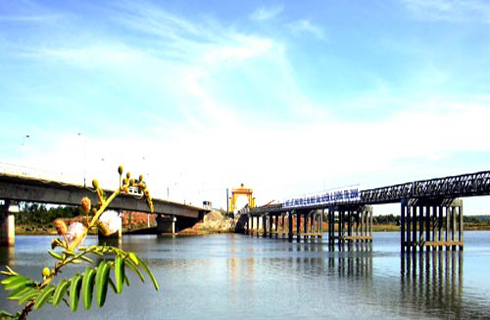
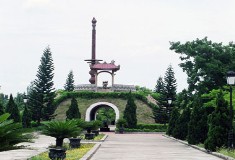 Quang Tri is located in Central Vietnam near the crossways between North and South Vietnam, Laos, and Thailand. Several different minorities populate in this province (Kinh, Bru-Van Kieu). Famous sites in Quang Tri include Quang Tri Citadel and the holy land of La Vang. Violent battles took place in Quang Tri during the war against the Americans; such battles have left revolutionary vestiges such as Hien Luong Bridge, Tung Gate, and Vinh Moc underground tunnels.
Quang Tri is a province in the North Central Coast of Vietnam. Like Dien Bien province, Quang Tri is also a historical land by passing vicissitudes in the past. Nowadays, Quang Tri is gradually becoming a tourist destination in the Central Vietnam. With an area of 4745.7 km2, Quang Tri is the home of more than 616,000 people of various ethnic minorities like Van Kieu, Chinese, Ta Oi…
About geography, the highlands, characterized by steep slopes, sharp crests, and narrow valleys, are covered mainly by a dense broadleaf evergreen forest. Most of the peaks are from 4,000 feet (1,200 m) to 7,000 feet (2,100 m) high, but some rise above 8,000 feet (2,400 m). The narrow coastal plains flanking the highlands on the east have rocky headlands and consist of belts of sand dunes and, in areas where the soil is suitable, rice fields. From the crests that mark the drainage divide in the highlands, streams flow either east towards the South China Sea or west into Laos or Cambodia. Those flowing eastward follow short courses through deep narrow valleys over rocky bottoms until they reach the coastal plains, where they slow down and disperse. The westward flowing streams follow longer traces, sometimes through deep canyons which are subject to seasonal flooding. The weather features a wide range of temperatures and rainfall, with hot and dry south-west winds during the Southwest Monsoon (May through September), and much cooler wet weather during the rainy season (November to mid-March). Annual average temperature is 24 °C, but temperatures can drop as low as 7 °C during the rainy season.
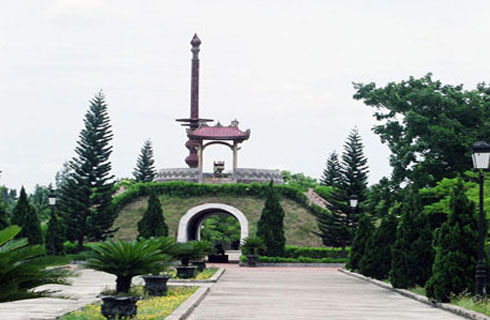
About the tourist destination, Quang Tri boasts many historical relics and monuments as well as beautiful landscapes. Some prominent sites that you can’t miss are Ben Hai River, Hien Luong Bridge, Truong Son Cemetery, Military Barrack of Khe Sanh, Con Co Island, Vinh Moc Tunnel, Ancient Citadel of Quang Tri and Cua Tung Beach…
Quang Tri Travel Information
Things to do
Cua Tung Beach
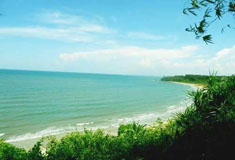 The Cua Tung Beach is located in Vinh Linh District. Although Cua Tung Beach is not very wide or long, it has its own beauty. The beach has sparkling green water, silky sand, and it is touched by soft breezes throughout the year. It is very pleasant to go on a boat down stream on the Ben Hai River and view the beautiful landscape. From Hien Luong Bridge, the tour boat will bring visitors along the river where rice and maize fields, green bamboo belts, rows of Casuarinas trees, and villages are visible far off into the distance. In the evening, there are many albatross flying across the sky and diving down into the green water. As night falls, it is time for wind and sea music, the sound of the waves and the whisper made by the rows of casuarinas trees. Cua Tung Beach is no doubt a great place for both a holiday and a rest. In 1976, the Ministry of Culture and Information recognized Vinh Moc Tunnels as national heritage site and included it in a list of especially important historical sites. To ensure security for visitors, the tunnels were restored with reinforced concrete and internal lightening.
Quang Tri Citadel
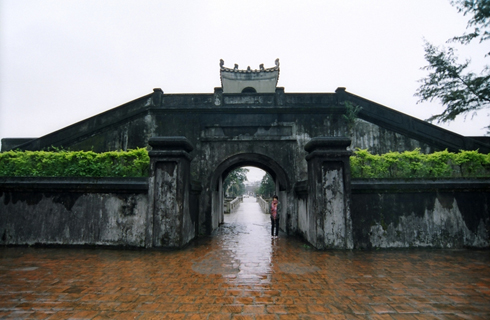
Quang Tri Citadel was built in 1824, during the 4th year of the reign of Minh Mang. The citadel is approximately 60km north of Hue.
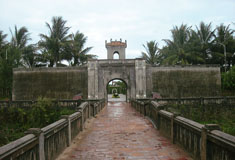 The citadel had a style of Vauban architecture with its circuit of 2,160m – one door each side. There were four fortresses jutting out from each four corners to control the four citadel gates. Inside was the town palace surrounded by a system of thick walls with circuit of 400m. The town palace was a three-roomed house whose two wings were used as places for the King to worship, and to give promotions to his inferiors or to occasionally celebrate festivals. Outside the town palace, there were a flagpole and castles such as Tuan Vu, An Sat and Lanh Binh and a rice store, etc and under the French domination, soldier camp and tax agency were added. However there are no remains of the past there nowadays – due to the destruction of U.S bombs in the hot summer of 1972.
The incident of 81 days and nights (from June 28 to September 16, 1972) has made this citadel well-known all over the world. By using fire-power, the South Vietnam puppet troop was determined to re-occupy Quang Tri Citadel within a couple of days. Quang Tri Town, therefore, had to suffer from the U.S bombardment and shelling of 140 B52 aircraft in turn, more than 200 tactical planes, 12 – 16 fighter planes and cruisers. Within 40 days and nights it had suffered 80,000 tons of bombs – as many as that in the World War II in African battlefield within a month. Sometimes the number of bombs dropped in Quang Tri a day was far more than that on the whole South battlefield in the years of 1968-1969. Especially, on July 25, there were 5,000 shells fired at an area of 3km2 of Quang Tri and its vicinity once suffered 20,000 shells of big size a day. The US aggressors used bombs and shells with their destructive capacity, to destroy Quang Tri, equivalent to 7 atomic bombs they dropped onto Hiroshima and Nagasaki – Japan in 1945. It is, really, unbelievable that each inhabitant in this land had to suffer 7 tons of bombs averagely. All were determined, side by side with Quang Tri to fight to their last breath. The Northern people had saved everything such as: ammunition, food and etc. to send to Quang Tri.
The citadel has gone down in history as a glorious period of the nation’s war against foreign invasion. The Vietnamese people are proud of it, and foreigners admire it.
Khe Sanh Base
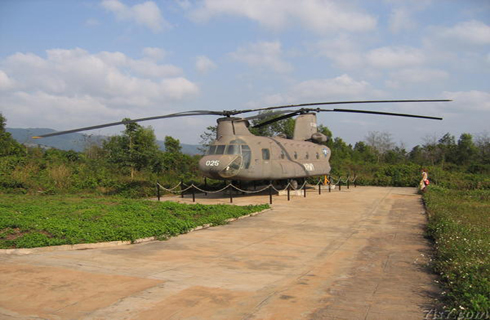
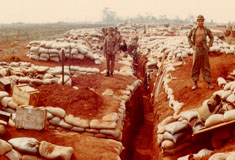 The Khe Sanh Combat Base was a U.S. Marine outpost in South Vietnam 16o39'16"N, 16o43'51"E used during the Vietnam War. The airstrip was built in September 1962. Fighting began there in late April of 1967 known as the "Hill Fights", which later expanded into the 1968 Battle of Khe Sanh. U.S. commanders provoked the battle, hoping that the North Vietnamese Army would attempt to repeat their famous victory at the Battle of Dien Bien Phu. On July 5, 1968, Khe Sanh was abandoned, the U.S. Army citing the vulnerability of the base to enemy artillery. However, the closure permitted the 3d Marine Division to construct mobile firebase operations along the northern border area. In 1971 Khe Sanh was reactivated to support Operation Lam Son 719, the South Vietnamese incursion into Laos. It was abandoned again sometime in 1972. In March 1973, American officials in Saigon reported that North Vietnamese troops had rebuilt the old airstrip at Khe Sanh and were using it for courier flights into the south. Today Khe Sanh Combat Base is musuem where relicts of the war are exhibited. Much of the actual airstrip is now overgrown by wilderness oder coffee and banana plants. The Australian rock group Cold Chisel used "Khe Sanh" for the title of a song about Australia's participation on the anti-communist side in the Vietnam War. The song, written from the perspective of a veteran, describes the bitterness felt by many Australian conscripts following the war. The attack on Khe Sanh was one of the largest sieges during the war next to the Tet Offensive.
Truong Son Cemetery
Situated in Gio Linh district, Truong Son cemetery contains about 15, graves containing the remains of Vietnamese soldiers and civilians who died in defense of the Ho Chi Minh Trail. During the conflict, the North Vietnamese didn't have the resources to retrieve and transport bodies back to their home village, as they did in the south. So the dead here were often buried where they died, if they were buried at all. In the Vietnamese tradition, the soul of a body not buried properly will not be at rest, so after the war, as many of the remains as possible were retrieved and interred here -- but only a fraction of the estimated hundreds of thousand who died actually made it here. The graves are arranged in concentric circles by province and hamlet -- Vietnamese come to offer prayers for the dead, and even if they can't find the grave of the friend or relative they are looking for, they can at least offer their prayers among their neighbours.
Vietnamese Demilitarized Zone ( DMZ)
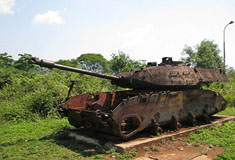 The Vietnamese Demilitarized Zone was established as a dividing line between North and South Vietnam as a result of the First Indochina War. During the Second Indochina War (popularly known as the Vietnam War), it became important as the battleground demarcation separating North Vietnamese territory from South Vietnamese territory. The DMZ ran east-west near the center of present-day Vietnam (spanning more than hundred kilometers) and was a couple of kilometers wide. It reached across into a beach on the east. An island nearby was controlled by North Vietnamese forces during the Vietnam War. The First Indochina War (also called the French Indochina War) was fought in Southeast Asia from 1946 through 1954 between the nation of France and the resistance movement led by Ho Chi Minh, called the Viet Minh. The Viet Minh, seasoned by combat against occupying Japanese soldiers during the Second World War, launched a rebellion against the French authority governing the colony of Indochina. After seven years of bloody conflict, the French made their last stand action Bien Phu, where they were engaged by the forces of General Vo Nguyen Giap. But contemporary military tactics were unable to defeat successive human wave attacks and the subsequent siege of the base; the French were defeated with devastating losses. The war in Indochina was not very popular with the French public, but the political stagnation of the Fourth Republic (following WWII German occupation) resulted in ongoing prosecution of the war. The United States supported France in the war politically and financially. The Geneva Conference on July 21, 1954 recognized the 17th parallel as a "provisional military demarcation line" temporarily dividing the country into two states, Communist North Vietnam and pro-Western South Vietnam. The Geneva Accords promised elections in 1956 to determine a national government for a united Vietnam. However, only France and the North Vietnamese government (DRV) signed the document. The U.S. and the government in Saigon refused to abide by the agreement, believing that the election would result in an easy victory for Ho Chi Minh. Emperor Bao Dai from his home in France appointed Ngo Dinh Diem as Prime Minister of South Vietnam. With American support, in 1955 Diem used a referendum to remove the former Emperor and declare himself as president of the Republic of Vietnam. Thus the competition for the whole of Vietnam began; Diem's military was unable to prevail in the civil war which escalated, as a result of international intervention, into the Vietnam War, which is also referred to as the Second Indochina War.
Things to eat
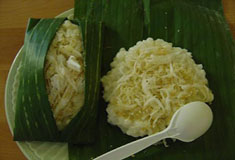 The specialty food of Quang Tri is stewed corn. This food is not available in many places; it is a delicious food that satisfies people. To have a delicious stewed corn, the preparation step is important. You need to choose the big and fresh corn. Next, cleaning it carefully and mashing in water for one day before cooking it. Stewed corn is sold widely on the street, so you can easily find out it. It is more delicious if it is packed by banana leaf.
Quang Tri Transportation
Dong Ha Town is 74km from Hue City, 80km from Lao Bao Border crossing, 94km from Dong Hoi (Quang Binh Province), 190km from Da Nang, 617km from Hanoi, and 1,112km from Ho Chi Minh City . National Highway No.1A runs through the province and National Highway No.9, the Trans-Asia Highway connects with the Lao Bao international border gate to Laos
Quang Tri Travel Tips
Coming to there, tourists are able to take interesting holiday in Dakrong Beauty Spot and Cua Tung Beach. The beach has sparkling clean water, silky sand and soft breeze, the whisper made by the rows of casuarinas trees. It is very pleasant to go on boat downstream on the Ben Hai River and admire the beautiful landscapes.